
(b.1878 – d.1959)
Born in Suffolk, England in 1878, Munnings left school at just 14 to apprentice as a lithographer, sketching and painting whenever he could. Horses quickly became his obsession. Not polished studio horses either — but real horses. Muddy hunters, cavalry mounts, carriage horses, restless thoroughbreds, gypsy cobs and farm horses standing quietly in fading afternoon light. He wanted movement, personality and life in his paintings.
Incredibly, after an accident as a young man, Munnings lost sight in his right eye. Many believed his career as an artist was over before it had truly begun. For a painter, the loss seemed catastrophic. But Munnings adapted, teaching himself to judge distance and depth differently, and somehow developed an even stronger sensitivity to motion and balance. What could have ended his career instead became part of the story that made him remarkable.
He was never drawn to stillness. Munnings loved speed, weather, unpredictability and atmosphere. If you look closely at many of his works, the horses are rarely posed stiffly. They are turning, sweating, pulling, galloping or standing alert with ears pricked toward something unseen. Riders lean forward against the wind, coats move with momentum, dogs dart through the foreground. His paintings feel alive because he understood that horses are never truly static creatures.
His relationship with horses was deeply personal. He rode regularly, hunted with hounds and immersed himself in rural equestrian culture throughout his life. Friends often described him as charismatic, emotional, outspoken and fiercely independent — traits that perhaps mirrored the very animals he painted. He admired courage and spirit, both in horses and people, and he had little patience for pretension.
One of the great constants in his life was his wife, Violet McBride, whom he married in 1920. Violet came from a cultured background and became not only his partner but also his emotional anchor. Their marriage brought stability to Munnings’ often fiery personality. She appeared in several of his paintings and accompanied him through the racing circuits, countryside gatherings and artistic circles that shaped their world. After his death, Violet worked tirelessly to preserve his legacy and helped ensure his paintings remained celebrated long after fashions in art had changed.
Munnings’ life was also shaped by war. During World War I he worked with the Canadian Cavalry Brigade, travelling through France and documenting mounted soldiers, transport horses and wartime scenes through paint rather than photography. These works now hold enormous historical value because they captured the final era when cavalry horses still played a major role in warfare. Many of the horses he painted were exhausted, mud-covered and battle-worn — yet he still painted them with dignity and individuality.

Lady Munnings Riding a Grey Hunter (‘Magnolia’) Side-Saddle, with Her Dogs on Exmoor 1924
As his reputation grew, so too did his fame within British society. He painted aristocrats, racing figures and prominent horsemen, eventually becoming President of the Royal Academy and receiving a knighthood. Yet despite these honours, Munnings remained famously outspoken and somewhat rebellious. One of the most repeated stories about him occurred late in life after a Royal Academy dinner, where — after several glasses of champagne — he delivered a fiery public speech criticising modern art and famously attacking Picasso. The moment became legendary within British art history and perfectly reflected Munnings’ stubborn loyalty to traditional craftsmanship and realism.
But beyond the titles, the speeches and the galleries, it was always horses that remained at the centre of his world.
There is something strangely familiar about his paintings to modern horse people. The damp coats after work. The nervous energy before movement. The quiet companionship between horse and rider. The sense that horses are not simply animals to be used, but personalities to be understood.
Perhaps that is why his work still resonates today. Even now, more than a century later, you can stand in front of a Munnings painting and almost hear the hoofbeats, feel the cold morning air or smell the leather and wet grass.
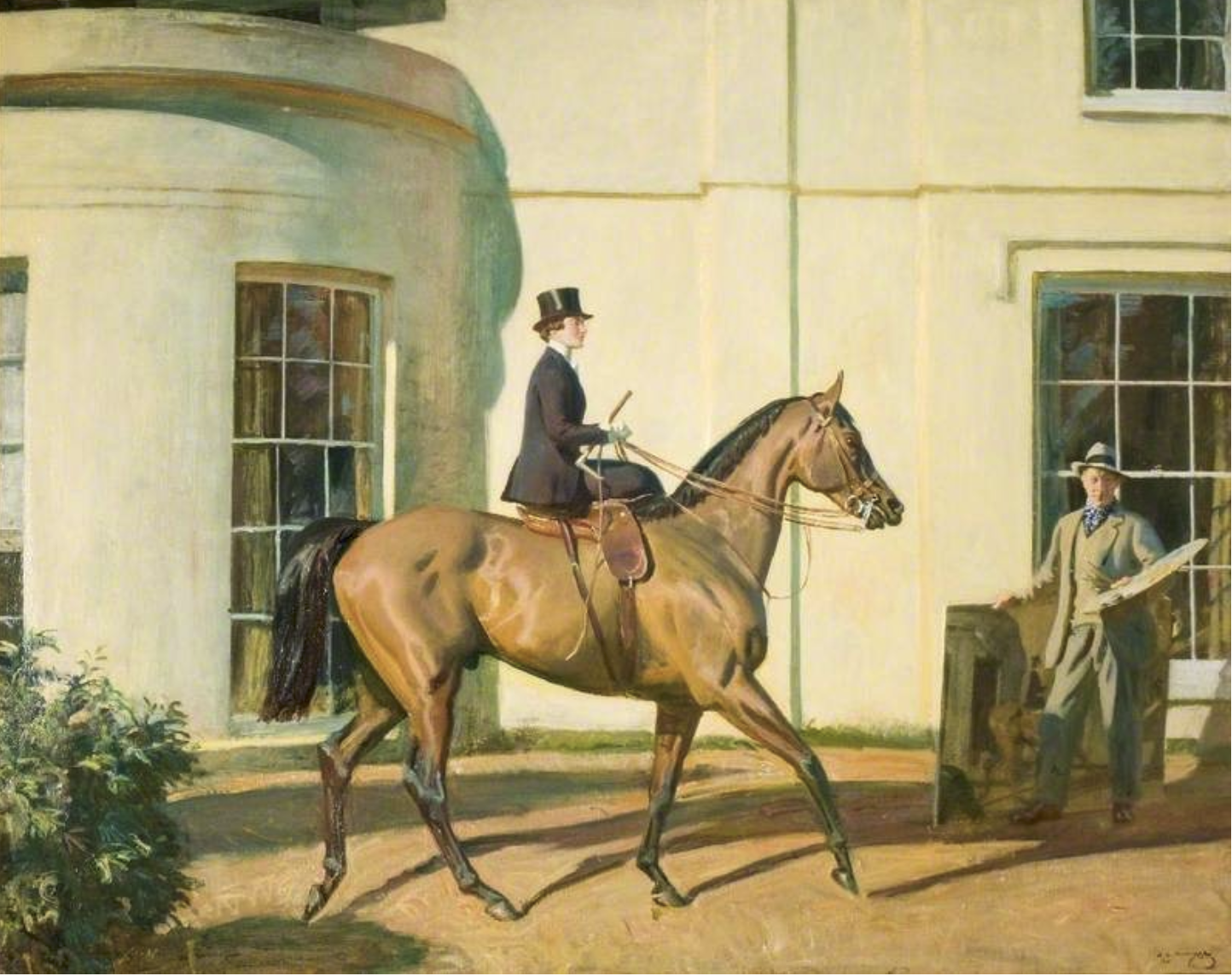
My Wife, My Horse and Myself exhibited 1935
Further details about Munnings life can be found below:
https://artuk.org/discover/stories/alfred-munnings-the-delight-of-painting-horses

