
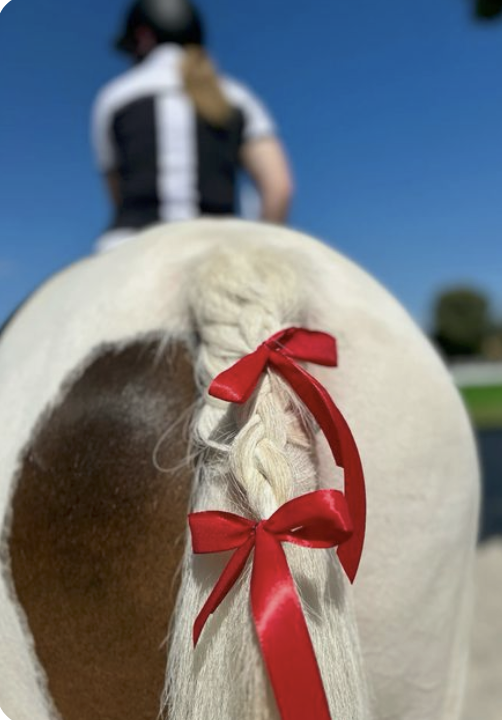
Ribbons are not merely decorative. In equestrian environments, they serve as critical, often unspoken safety signals for riders, handlers, and anyone in the vicinity of horses.
The placement of ribbons—on a horse’s tail or in the forelock—communicates important information about that horse’s behaviour:
- Red ribbon in the tail: Indicates the horse may kick.
- Red ribbon in the forelock: Suggests the horse may be horse ‘shy’.
- Green ribbon: Identifies a young or inexperienced horse, and signals to others to allow additional space, as these horses may be more reactive or unsettled in a competition environment.
Green ribbons also act as a courtesy signal to those outside the arena—these horses are still learning and may be more sensitive to noise, movement, and unfamiliar surroundings.
It is important to note that ribbon meanings can vary by region. In the United Kingdom, for example, a white ribbon may indicate a horse is for sale, while a pink ribbon can signal a mare in season. A yellow ribbon is commonly used to identify a stallion, whereas in Australia a fluoro green disc is more typical, and a blue ribbon may be used to indicate an aggressive stallion. Research online has indicated that a red ribbon in the forelock, at localised events in the USA, suggest a horse may strike or bite.
Rules vs Etiquette in Australia
In Australia, there is no formal regulation governing most ribbon colours. Their use largely sits within shared equestrian etiquette and community understanding.
However, under Equestrian Australia rules—particularly in dressage—there are clear restrictions:
- Ribbons and decorations are generally not permitted on the horse.
- The only exception is a red ribbon in the tail, which is explicitly allowed as a safety warning for a horse that may kick.
- Any other ribbon or decorative item may result in elimination if used in the competition arena.
This creates an important distinction:
- In the competition arena (especially dressage) → rules apply, and only the red tail ribbon is permitted.
- In warm-up areas, training days, and informal settings → a broader range of ribbon colours may be used as courtesy signals to support safety and awareness.
A Shared Responsibility
As safety remains paramount when working with large animals in shared spaces, these small visual cues play a significant role in preventing incidents.
Please take note of the signals other riders are providing—and adjust your behaviour accordingly.
Likewise, if your horse has a tendency to kick or be horse shy, it is your responsibility to clearly communicate this by using the appropriate ribbon where permitted. This simple act of awareness protects not only others, but also you and your horse.

