How did you first become involved in course building, and what drew you to that side of the sport?
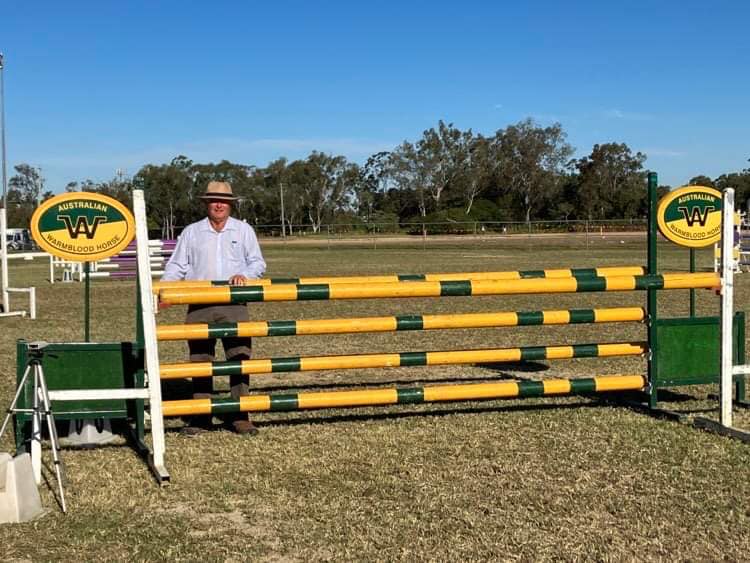
My journey into course designing began when my children joined pony club. They needed a course designer for an upcoming competition and I said I could build it if they got me a design. I found that I enjoyed it and I’ve been actively involved ever since.
Did you compete or ride yourself, and do you think that experience shapes how you build courses today?
Yes, I did ride and compete at a reasonable level in both eventing and show jumping. Unfortunately, my dressage skills were never very strong. I typically achieved double clears in cross country and show jumping but struggled to secure wins due to my dressage scores. Eventually, I decided to focus solely on show jumping as my heart said eventing but my head said showjumping. My experience as a rider allows me to understand the nuances of course challenges from a rider’s perspective.
What do you enjoy most about course building compared to riding or coaching?
I think it’s the challenge of creating a good track that’s fair and encouraging while also being challenging for competitive riders. While I do enjoy coaching, it can be difficult because you’re trying to work through the rider to achieve the results you want to see in the horse. As for riding, I only do trail riding these days which I thoroughly enjoy and do very little on educating, though I know my horse might be better behaved if I incorporated more training and education into our routine.
When you design a course, what is the first thing you think about—horse welfare, rider flow, technical challenge, or something else?
When designing the foremost consideration is ensuring the course flows smoothly. A well-flowing course naturally supports the welfare of both horse and rider.
Technical difficulty is another important element, but it must be tailored to the specific class and level of the competition. In classes designed for young or inexperienced horses, simplicity and encouragement are key. The course should avoid overwhelming the horse with complex obstacles or tight turns, instead giving confidence and positive experiences. This approach helps young horses develop their skills gradually and enjoy jumping.
More advanced courses, such as those set at heights above 1.2 meters, offer the designer greater freedom to introduce subtle technical challenges. These can include lines and obstacles that test the precision, agility, and partnership between horse and rider. Here, the challenge is to strike the perfect balance between demanding enough to stimulate improvement and not so difficult as to compromise safety or flow.
What makes a course ‘educational’ rather than just difficult?
The distinction between an educational course and one that is merely difficult is crucial. While difficulty often implies challenge, an educational course aims to foster learning, growth, and skill development in both riders and horses.
A well-designed course offers riders multiple options, such as challenging inside lines for those wanting to test their precision and control, alongside longer, safer outside options that allow less experienced combinations to navigate successfully.
A course that is simply difficult tends to focus on punishing mistakes rather than promoting learning. Excessive traps, unfair challenges, or overly punishing obstacles can create frustration rather than growth. Such courses often fail to consider the combinations development and instead pose an unnecessary barrier, making them essentially “bad” courses unless specifically designed for elite combinations.
The course designer doesn’t need to introduce traps in their courses. The rider and horse will make enough mistakes all on their own. The aim should be to offer difficulty that educates and enhances the rider’s abilities without causing undue discouragement.
From your perspective, how has showjumping changed since you first became involved—for better or worse?
Since I first became involved in the sport. One of the major changes is the shift in the breed of horses used. When I began, thoroughbreds dominated the scene, prized for their natural athleticism. Nowadays, warmbloods have become the preferred choice, largely due to their improved athleticism.
Another difference lies in the stride length of the horses competing in higher-level classes. Historically, the average stride length was around 12 feet (approximately 3.65 meters). Today, this has increased slightly to about 3.8 meters. Interestingly, the thoroughbreds of the past could easily match the warmbloods of today.
The problem with the thoroughbred today is that the breed itself has evolved over the last five decades. Breeding priorities have shifted towards producing sprinters rather than larger, endurance-focused stayers. This change has impacted their natural jumping ability; in my youth, nearly every thoroughbred possessed the ability to jump at least 1m. In contrast, some of the thoroughbreds of today struggle to jump 80cms, reflecting a decline in their popularity and suitability for showjumping.
These changes illustrate the dynamic nature of the sport and its equine athletes. While warmbloods have brought consistent strength and reliability to showjumping, the transformation of thoroughbreds highlights how breeding focus can influence performance traits over time.
Have you noticed changes in the sport, or expectations over time?
Show jumping has changed a lot over time, from the equipment used, rules, regulations and compliance to the frequency and nature of competitions, as well as all the financial dynamics involved. Officials are better educated and there is much more emphasis on the safety and welfare of the horse than there used to be, which is a positive for the sport.
One of the most immediately visible changes when you drive into an event is the size and style of the trucks used by competitors. Compared to earlier days, these vehicles have become significantly larger and much flashier, symbolizing a shift towards a more polished and professional image within the sport.
In the past, agricultural shows were a cornerstone of the equestrian calendar, with nearly every sizeable town hosting such events where show jumping featured prominently. Locally, there used to be around a dozen agricultural shows offering competitive opportunities. Today, however, only one agricultural show in my area continues to include show jumping, highlighting a decline in these traditional venues. Additionally, facilities dedicated to jump clubs were scarce when the sport was emerging, with places like Boneo either non-existent or in their infancy, marking a stark contrast to the more developed infrastructure available now.
Back in the day when I was competing prize money was a lot higher; a successful weekend at a competition could yield earnings comparable to a full week’s wages. Nowadays, the comparable monetary rewards have diminished. There are a lot more fees and expenses involved in competing now and I feel this is having an impact on numbers at shows in the current economic climate.
What is a common mistake riders make when walking a course, and what should they focus on instead?
I think a common mistake some riders make is: they fail to walk their lines properly. This oversight can impact on their performance. Understanding how to walk the course correctly helps riders plan their approach, timing, and rhythm, which are essential for a smooth and confident round.
When dealing with unrelated lines they should use the “3 stride rule” before and after the fence. Riders need to walk away from the fence for 3 strides to pick a place where they start to turn, then turn so that they are straight 3 strides in front of the next fence. Instead of obsessively counting every stride around the entire course, riders should focus on being in this spot (3 strides in front of the fence) aiming to land on it with their horse engaged and maintaining a steady rhythm.
Related lines, where fences are set at fixed distances, are somewhat easier since counting strides is straightforward. However, riders must still consider their horse’s level of engagement at that stage of the course. For example, a related line located early in the course and away from the gate might feel short when walking but longer when ridden. Conversely, later in the course, lines heading toward the gate may feel longer on foot but ride short. Being mindful of these nuances helps riders adjust their strategy accordingly.
What do you hope riders feel when they finish one of your courses—regardless of the result?
That the course was fair and encouraging. Ultimately, the hope is that riders walk away feeling that the course was an opportunity for growth for both horse and rider. It’s about nurturing skill and confidence, ensuring every participant leaves motivated and ready for the next challenge.
If you could give one piece of advice to riders walking into the ring at this event, what would it be?
One piece of advice for a successful round is: establish a good canter and rhythm well before reaching the start line. Maintain that good canter and rhythm for the whole course and ride your lines. This sets the tone for the entire course and can significantly influence the outcome of your performance.