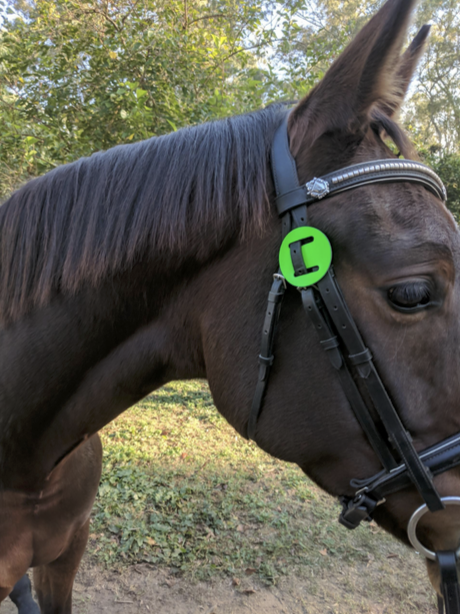
Equestrian Australia have clear regulations when bringing a stallion to a competition, including the correct identification, which must be clearly displayed on both sides of the horse’s head (attached to bridle or halter) or both sides of the saddle cloth or clearly displayed on both sides of the breastplate or martingale. It may be in the form of bridle number holder Identification or the disc identification.
The disc or number holder must not be obscured by clothing or other items.
It is compulsory at all EA affiliated events for stallion owners/riders/grooms and any other
person in charge of a stallion to ensure they are easily identifiable at all times.
The following EA rules apply:
- All colts/stallions over the age of 12 months must wear compliant green Stallion
Identification by way of discs/bridle number holders and a suitable restraint at all times
whilst away from their home premises at an event. - When in competition, the correct identification must be clearly displayed on both sides of
the horse’s head (attached to bridle or halter) or both sides of the saddle cloth or clearly
displayed on both sides of the breastplate or martingale:
i. the bridle number holder Identification *see example below; or
ii. the disc identification
Clearly displayed means the identification must not be obscured by for example, clothing
or other items. - Trucks and/or trailers that transport any colt/stallion must display the EA Stallion
Identification Card with a green background. See example on below; giving notice
that there is a colt/stallion on board. - When tied to a truck or trailer, the colt/stallion must be suitably restrained or yarded within
an approved solid framed portable yard and must display the EA Stallion Identification
Card with a green background and should also be wearing the correct identification as per
point 2. - When staying overnight at an event or show, colt/stallion owners must advise the Event
Organising Committee when entering and booking horse accommodation that they are
bringing a colt/stallion. - The placement of colts/stallions require the consideration to mares and other horses when
being allocated yards or stables by the Event Organising Committee. - The EA Stallion Identification Card with a green background must be placed on the outside
of the stable or yard clearly notifying others that the horse within is a colt/stallion. It must
also display the name and contact details (including phone number) for the rider or person
responsible for the colt/stallion during the event. - Colts/stallions may be substituted in prize-giving ceremonies with another horse should
the rider, officials or Event Organising Committee deem it to be safer. - Riders and/or handlers of colts/stallions must be over the age of 18 years. Special
permission may be granted by the relevant EA National Discipline Committee for a
rider/handler to be under the age of 18 years, and in this instance, the rider/handler must
be supervised by an adult/parent/guardian whilst at the event. This exemption does not
apply for Dressage (refer to rule 4.8.4.2 EA Dressage Rules). - Stallions are not permitted in Show Horse Classes (refer rule 1.1.9 of EA Show Horse
Rules). - The Organising Committee reserve the right to refuse entry, or remove from competition
at any stage, a colt/stallion deemed to be a danger to people or other horses.
*Example of EA branded green Stallion bridle & saddle cloth number holder Identification
**Example of Stallion Identification Card with green background, which can be downloaded
from https://www.equestrian.org.au/stallion-safe-practice
The above information has been collected from: https://www.equestrian.org.au/sites/default/files/EA_Stallion_Safe_Practice_Policy_October_2021_Clean.pdf


